

Many teachers spend hours refining lesson slides, writing learning intentions, developing success criteria, and planning examples.
Yet one of the biggest influences on lesson success is often overlooked.
Student routines.
You can have a well-structured lesson, a strong explanation, and carefully sequenced examples. But if students do not know how to participate during different parts of the lesson, instruction becomes less effective.
Students need to be taught how to learn within the lesson structure.
Why Classroom Routines Matter
When we think about classroom expectations, many of us immediately think about behaviour.
However, instructional routines are different.
Instructional routines help students understand what successful participation looks like during learning.
For example:
What should students be doing while the teacher is modelling?
What should partner talk sound like?
How should students participate during guided practice?
How should students use success criteria during independent work?
These behaviours are rarely automatic.
They need to be taught, practised, and revisited throughout the year.
The Problem with Generic Expectations
Many classrooms display posters that encourage students to:
Be respectful
Be responsible
Be safe
While these messages are important, they often fail to provide students with clear guidance during learning.
A student may know they are expected to be respectful, but do they know what successful participation looks like during an I Do lesson?
Do they know how to engage during partner talk?
Do they know how to use success criteria to improve their work?
Instructional routines make these expectations visible and actionable.
The Routines That Support Structured Teaching

The classroom routines pack I recently created focuses on the specific routines students encounter throughout a structured lesson sequence.
These include:
Our Lesson Routine
Helping students understand the flow of a lesson and where they are in the learning process.
How to Succeed During I Do
Supporting students to listen, focus, and engage while new learning is being introduced and modelled.
How to Succeed During We Do
Clarifying expectations during guided practice and shared learning.
How to Succeed During Partner Talk
Teaching students how to participate in meaningful academic discussions.
How to Succeed with Mini Whiteboards
Establishing routines that maximise participation and checking for understanding.
How to Succeed During You Do
Supporting students during independent practice and application.
How to Use Success Criteria
Helping students use success criteria as a learning tool rather than simply a checklist displayed on the board.
How to Review Your Learning
Encouraging reflection and consolidation at the end of a lesson.
Teaching Routines Is More Important Than Displaying Them
A poster alone will not change classroom behaviour.
The most effective classrooms explicitly teach routines.
This involves:
Explaining the routine
Modelling the routine
Practising the routine
Providing feedback
Revisiting the routine regularly
Just as we teach academic content, we need to teach students how to participate successfully during learning.
Free Classroom Routines Posters
👉Get the free Structured Teaching Student Routines Pack here
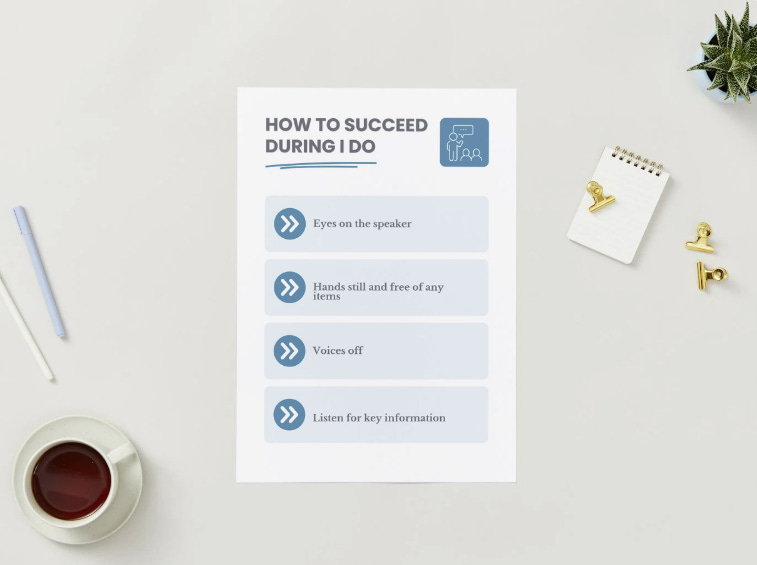
To support teachers implementing structured teaching practices, I have created a free Classroom Routines Poster Pack.
The pack includes classroom posters designed to support:
Lesson routines
Guided practice
Partner talk
Mini whiteboards
Success criteria
Independent learning
Reflection


Want to Go Further?
The posters are designed to support implementation.
Below I provide practical guidance to help you embed these routines within a structured teaching framework.
The goal is not simply to display routines.
The goal is to create classrooms where students know exactly how to participate, engage, and succeed during learning.
🎧Listen to the practical audio training below that walks through:
How to introduce instructional routines at the beginning of the year or term
Which routines to prioritise first
How to explicitly teach classroom participation expectations
How to use the posters throughout your lessons
Common mistakes that reduce effectiveness
Strategies for building routines that become automatic over time
