

Already a Structured Teaching Portal member?
Graphic organisers can be incredibly useful during explicit teaching, but simply handing students a worksheet does not necessarily support learning.
The value comes from how the organiser is used within the lesson.
When graphic organisers are introduced during modelled instruction, completed with students during guided practice and then used independently once students are ready, they can help make thinking visible and give students a clear structure for organising what they are learning.
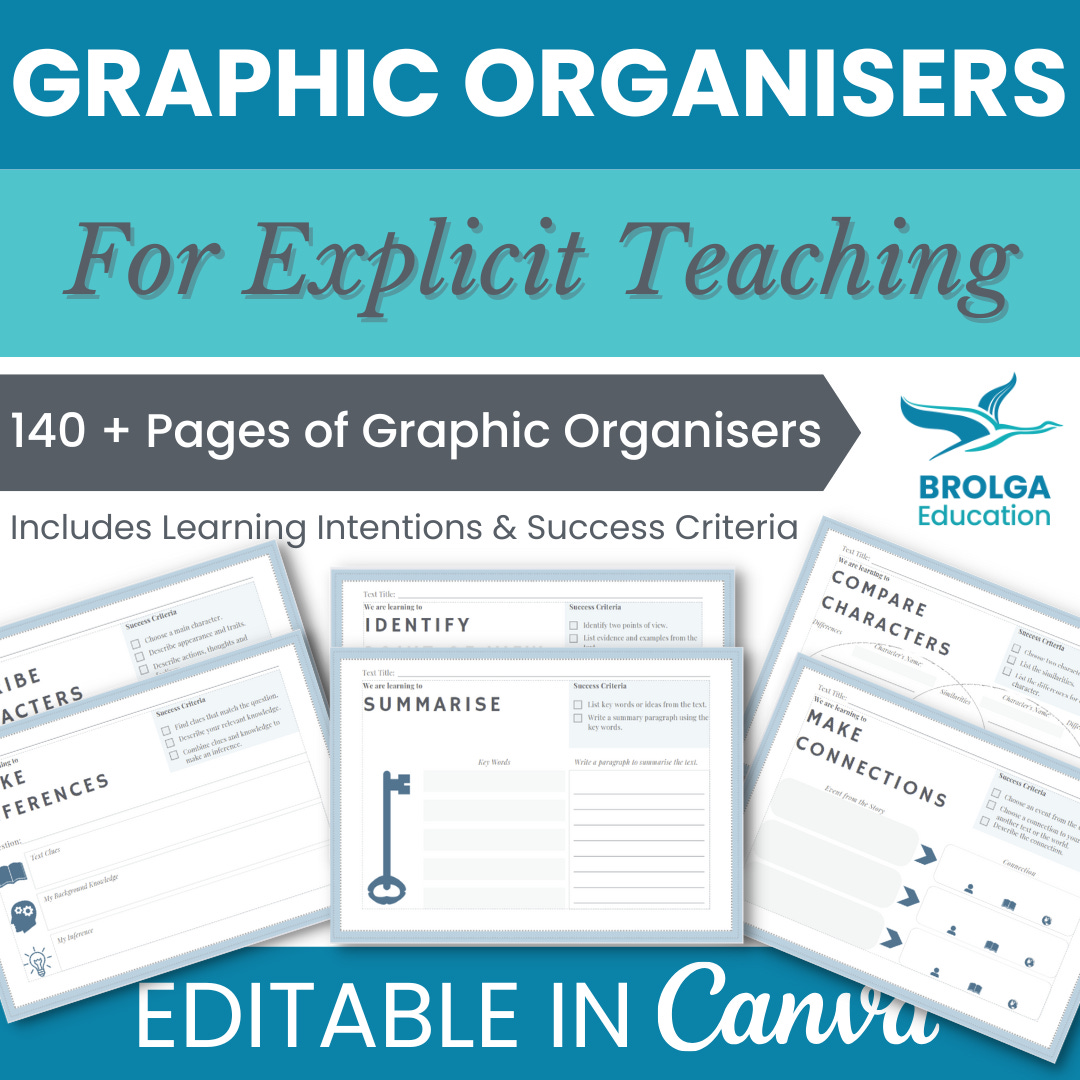
I have brought together my Graphic Organisers for Explicit Teaching collection inside the Structured Teaching Portal, with resources for reading, mathematics, brainstorming, modelling and general classroom use.
Why Use Graphic Organisers in Explicit Teaching?
One of the principles of explicit teaching is that we do not leave students to work out complex processes for themselves.
We make the thinking visible.
A well-designed graphic organiser can provide students with a visual structure for that thinking.
For example, rather than simply asking students to compare two characters, we can explicitly model how we identify similarities and differences and record that thinking within a comparison organiser.
Rather than telling students to summarise a text, we can model how we identify the key information, decide what is important and organise those ideas before constructing a summary.
The graphic organiser does not replace explicit instruction.
It provides a structure through which explicit instruction can occur.
Graphic Organisers Across the I Do, We Do, You Do
Graphic organisers are particularly powerful when they move with students through the gradual release of responsibility.
I Do: Model the Thinking
During modelled instruction, display the graphic organiser and explicitly demonstrate how you would complete it.
This is an opportunity to think aloud.
Show students:
what information you are looking for
how you decide what is important
where information belongs
how different ideas connect
what a successful response looks like
Students are not simply seeing the finished organiser. They are seeing the thinking required to create it.
We Do: Complete It Together
During guided practice, use the same or a similar organiser while students contribute to the thinking.
Ask questions, check for understanding and provide immediate feedback as students begin applying the process themselves.
You can gradually increase how much of the organiser students complete while still providing the support they need.
You Do: Apply the Process Independently
Once students have demonstrated that they understand the process, the organiser can become a scaffold for independent practice.
Students now have a familiar structure that allows them to focus their attention on applying the knowledge or skill rather than working out how to organise their response.
As students develop greater expertise, that scaffold can also be gradually reduced where appropriate.
Choose the Organiser Based on the Learning
A graphic organiser should have an instructional purpose.
The question is not:
“Which worksheet should I give students?”
It is:
“What thinking do I need students to do?”
If students need to compare ideas, a Venn diagram or comparison organiser may support that thinking.
If they need to understand a sequence, a timeline or sequencing organiser may be appropriate.
If they are learning to summarise, make connections, identify a point of view or make inferences, the organiser should reflect that particular thinking process.
For mathematics, an organiser might help students represent a concept, record their mathematical reasoning or work through a problem-solving process.
The organiser follows the learning intention, not the other way around.
Make the Success Criteria Visible
Many of the graphic organisers in this collection include space for Learning Intentions and Success Criteria.
This allows the task to remain connected to the learning taking place in the lesson.
Before students begin, make sure they understand:
what they are learning
what they are being asked to do
what a successful response will include
You can then refer students back to the success criteria while modelling, during guided practice and when providing feedback.
Editable and Reusable Resources
The collection includes both editable Canva resources and ready-to-use PDF resources, depending on the bundle.
The editable templates allow you to adapt the organisers to the content you are teaching, while the PDF collections give you organisers that can be printed and used as needed.
Rather than creating a new organiser every time you teach a skill, you can build familiar structures into your lessons and reuse them across different curriculum areas and topics.