

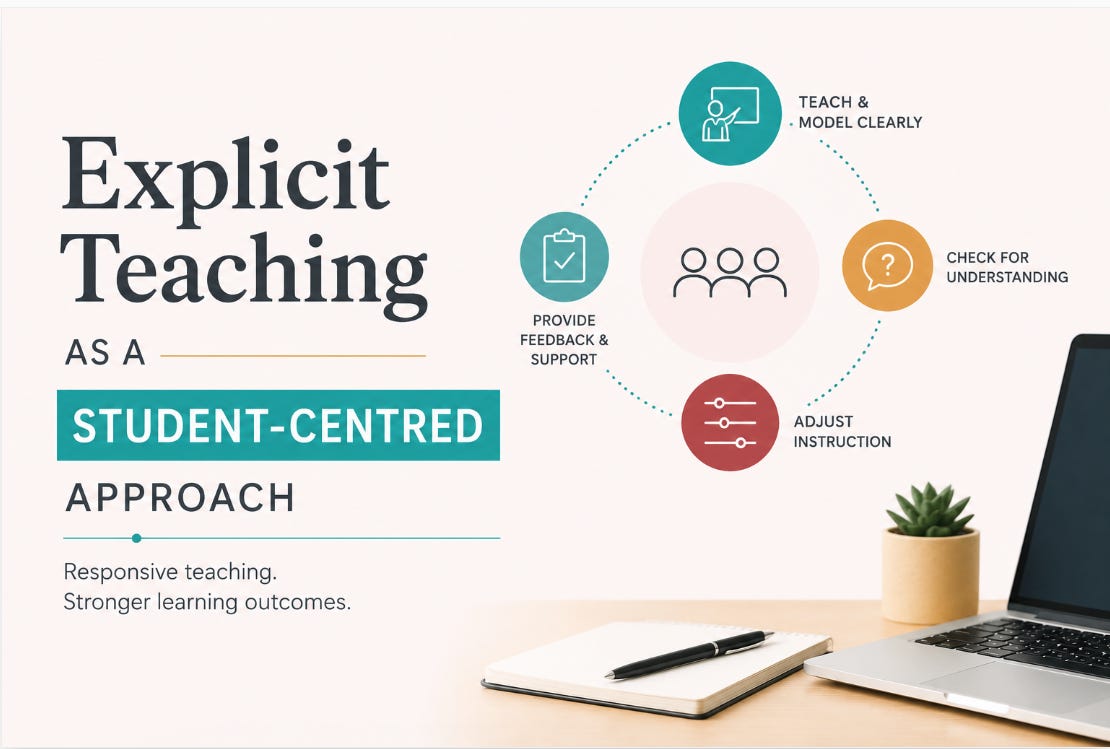
If explicit teaching is teacher-centred, why do so many students learn more when we use it?
🎧 Listen to the voice note below where I unpack the idea that explicit teaching is teacher-centred
One of the most persistent misconceptions in education is the idea that explicit teaching is inherently teacher-centred.
In many cases, I think this misconception has developed because explicit teaching has become confused with presentation-centred teaching.
Teachers are increasingly being told they need more slides, more animations, more worked examples embedded into PowerPoint presentations, and more content delivered from the front of the room.
The result is often a lesson where the teacher spends most of their time clicking through a presentation and talking to a screen.
That is not explicit teaching.
That is presenting. The irony is that this version of explicit teaching often appears teacher-centred because the teacher is interacting more with the presentation than with the students.
Good explicit teaching looks very different.
True explicit teaching is responsive. It requires the teacher to constantly gather information about student understanding and adjust instruction in real time.
A teacher delivering explicit instruction is not focused on getting through their slides.
They are focused on what students understand, what they are struggling with, and what support they need next.
This is why explicit teaching is far more student-centred than many people realise.
The teacher may be leading the learning, but the lesson is constantly adapting to student needs.

What Student-Centred Learning Really Means
A student-centred classroom is not defined by who is doing the talking.
It is defined by whether instructional decisions are being made in response to student learning.
Good explicit teaching is highly responsive because the teacher is continuously monitoring understanding throughout the lesson.
This includes:
Quick checks for understanding throughout the lesson
Engagement norms and instructional routines
Questioning and discussion
Monitoring student responses on the mini whiteboards
Adjusting explanations when confusion emerges
Providing additional modelling when required
Offering immediate feedback
Increasing or reducing support based on student performance
These are all student-centred practices because they place student learning at the centre of every instructional decision.
The teacher is not following a script.
The teacher is responding to evidence.
Why Some Students Struggle When We Skip Explicit Teaching
The challenge with many discovery-based approaches is that they often assume students already possess the knowledge and skills required to engage successfully with complex tasks.
Many students do not.
Some students are still developing foundational knowledge.
Others may have gaps from previous years.
Some may simply be encountering a concept for the first time.
When these students are asked to independently solve problems, investigate concepts, or complete project-based learning without sufficient background knowledge, they can quickly become overwhelmed.
The issue is not the project.
The issue is the missing foundation.
Students cannot successfully apply knowledge they have never been taught.
This is why explicit teaching remains so important.
It provides students with the foundational skills, vocabulary, concepts, and procedures they need before asking them to work independently.
Once students have developed that foundation, richer learning opportunities become far more accessible.
This is where many people misunderstand explicit teaching.
Explicit teaching is not the destination.
It is the bridge.
When students have mastered the necessary knowledge and skills, teachers can gradually release responsibility and provide opportunities for inquiry, problem-solving, project-based learning, and independent application.
The difference is that students are no longer guessing.
They have the tools they need to succeed.
How to Apply This in Your Classroom
Understanding why explicit teaching is student-centred is only the first step.
The real challenge is translating these principles into daily classroom practice.
That is where lesson structure, instructional routines, guided practice, and feedback systems become critical.
If you are looking for practical support, the Structured Teaching Portal includes the exact frameworks, lesson templates, audio trainings, and classroom resources I use to help teachers implement explicit teaching effectively.

Continue Reading:
Explicit Teaching Resources:
Brolga Education
Created by Trudy Mayo — explicit teaching coach & curriculum specialist.
500+ lessons written in explicit instruction | 1k+ teacher subs
I help teachers plan & deliver clear lessons | Simplifying explicit instruction that engages & drives progress🌟
💌 New here? 📚 Follow on Instagram for daily tips & behind-the-scenes: @brolgaeducation
The confusion between teacher centred and presentation centred teaching I think is well put, with the portrayal often being that of a dry, repetitive, draconian instructor. I suppose it's easy to mistake someone talking at the front for explicit instruction when in reality the defining feature, as you say, is how responsive the teacher is to what the children are actually understanding in the moment.
I'm curious whether you think this misconception has grown because people tend to judge lessons by what they look like on the surface rather than by the decision making that's happening at a deeper level? Would you say observations done by senior leaders and inspectors often fall privy to this kind of superficial assessment?
You make a lot of assumptions that students don’t know a lot going into it - how do you know that?